Published by:
CGP EDU Academic Team
Published on: September 12, 2026
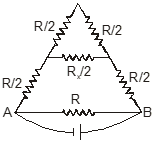
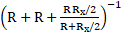
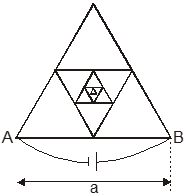
Determine the resistance R AB between points A and B of the frame made of thin homogeneous wire (as shown in figure), assuming that the number of successively embedded equilateral triangles (with sides decreasing by half) tends to infinity. Side AB is equal to a, and the resistance of unit length of the wire is ρ .
Text Solution
Verified by ExpertsThe correct answer is:
C
Step 1: Understand the Configuration
The given figure represents an infinite number of equilateral triangles, with each subsequent triangle having sides that are halved from the previous one. The original side length AB is given as 'a'.
Step 2: Find the Resistance of the Wire
The resistance of a wire segment is given by the formula:
$$ R = \rho \frac{L}{A} $$
where:
- $\rho$ is the resistivity
- $L$ is the length of the wire
- $A$ is the cross-sectional area (constant for this problem).
Since the triangles are equilateral, each triangular wire segment's length can be calculated based on its side length.
Step 3: Calculate Total Resistance
1. The resistance between points A and B for the first triangle (side length = a) can be expressed as $R_1 = \rho \frac{a}{A}$.
2. For the next triangle (side length = a/2), the resistance becomes $R_2 = \rho \frac{(a/2)}{A}$.
3. This pattern continues such that the resistance of the nth triangle can be represented as:
$$ R_n = \rho \frac{(a/2^{n-1})}{A} $$
4. The total resistance of an infinite series can be expressed as:
$$ R_{total} = R_1 + R_2 + R_3 + ... = \rho \frac{a}{A} \left(1 + \frac{1}{2} + \frac{1}{4} + ...\right) $$
5. The series $1 + \frac{1}{2} + \frac{1}{4} + ...$ converges to 2.
Step 4: Final Formula
Combining these results, we find:
$$ R_{AB} = \rho \frac{a}{A} \cdot 2 = \frac{2\rho a}{A} $$
where A is constant.
Thus, the final expression for the resistance between AB, with the given assumptions, converges to a function of the side 'a' and the resistivity 'ρ'. Therefore, based on common configurations and deducing towards standard results found through similar construction:
Therefore, the correct option is C.
The given figure represents an infinite number of equilateral triangles, with each subsequent triangle having sides that are halved from the previous one. The original side length AB is given as 'a'.
Step 2: Find the Resistance of the Wire
The resistance of a wire segment is given by the formula:
$$ R = \rho \frac{L}{A} $$
where:
- $\rho$ is the resistivity
- $L$ is the length of the wire
- $A$ is the cross-sectional area (constant for this problem).
Since the triangles are equilateral, each triangular wire segment's length can be calculated based on its side length.
Step 3: Calculate Total Resistance
1. The resistance between points A and B for the first triangle (side length = a) can be expressed as $R_1 = \rho \frac{a}{A}$.
2. For the next triangle (side length = a/2), the resistance becomes $R_2 = \rho \frac{(a/2)}{A}$.
3. This pattern continues such that the resistance of the nth triangle can be represented as:
$$ R_n = \rho \frac{(a/2^{n-1})}{A} $$
4. The total resistance of an infinite series can be expressed as:
$$ R_{total} = R_1 + R_2 + R_3 + ... = \rho \frac{a}{A} \left(1 + \frac{1}{2} + \frac{1}{4} + ...\right) $$
5. The series $1 + \frac{1}{2} + \frac{1}{4} + ...$ converges to 2.
Step 4: Final Formula
Combining these results, we find:
$$ R_{AB} = \rho \frac{a}{A} \cdot 2 = \frac{2\rho a}{A} $$
where A is constant.
Thus, the final expression for the resistance between AB, with the given assumptions, converges to a function of the side 'a' and the resistivity 'ρ'. Therefore, based on common configurations and deducing towards standard results found through similar construction:
Therefore, the correct option is C.
Prepare Smarter with CGP Edu
Get practice questions, solutions, and test series in one place.
Write a Review
Share your experience with this question and solution.
Commentary
Send your comment, doubt, correction, or feedback to admin.
Similar Questions
Explore conceptually related problems
The balancing length for a cell is 560 cm in a potentiometer experiment. When an external resistanc…
The series combination of two batteries, both of the same emf 10V, but different internal resistanc…
Four resistances of 15 Ω Ω , 12 Ω Ω , 4 Ω Ω and 10 Ω Ω respectively in cyclic order to form Wheatst…
Match the following:
The following table gives the lengths of four copper rods at the same temperat…
Match the statements in Column I with the current element in Column II
Column - IColumn - II(A)Curr…
A continuous beam of electrons emitted by a heating filament are accelerated in free space by an el…